
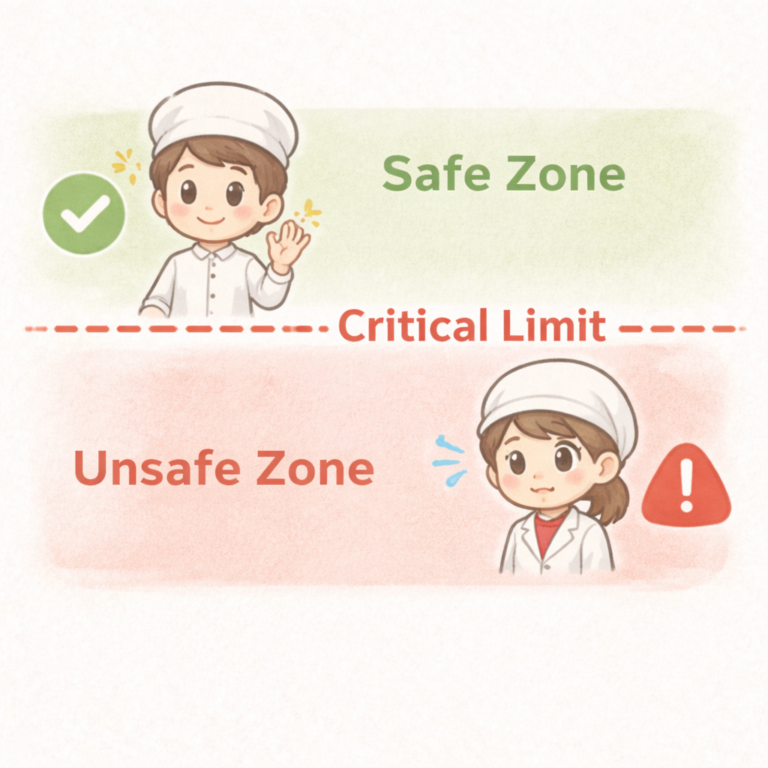
Critical limits in HACCP: how to set them correctly in food production
Many food businesses write critical limits in their HACCP plan. However, few define them properly.
As a result, the system looks complete. Records exist. Audits pass. Yet the control may not be strong enough to manage real hazards.
A critical limit is not just a number. It is the point where food safety is either controlled or lost.
If you run a central kitchen, food production facility, or growing F&B chain, you must set critical limits correctly. Otherwise, your HACCP system cannot protect your product.
As an ISO 22000 consultant in Singapore, we often see critical limits copied, guessed, or poorly defined. Let us break this down clearly.
What is a critical limit?
A critical limit is the boundary between safe and unsafe
- Minimum cooking temperature
- Maximum cooling time
- Maximum pH level
- Maximum water activity
Why critical limits matter
- Operators do not know what to aim for
- Monitoring becomes meaningless
- Deviations are unclear
- Corrective actions become inconsistent
- Clear decision points
- Consistent production
- Reliable food safety outcomes
- Better audit performance
Common mistakes in setting critical limits
Many businesses make the same errors.
Copy-paste limits
Some teams copy limits from templates or other companies. However, processes differ. Equipment differs. Product size differs. Therefore, copied limits may not apply to your operation.
Confusing targets with limits
A target is what you aim for. A critical limit is the minimum or maximum that must not be crossed.
- Target: cook to 80°C
- Critical limit: must reach at least 75°C
Limits that are not measurable
Some limits are written as:
- “Cook thoroughly”
- “Cool quickly”
These are not limits. They are instructions. A critical limit must be measurable.
No link to hazard
A limit must relate to a specific hazard. If you cannot explain what hazard it controls, the limit is weak.
How to set critical limits correctly
To set strong limits, follow a clear structure.
Step 1: Define the hazard clearly
Do not generalise. Instead of “bacteria,” specify:
- Salmonella
- Listeria monocytogenes
- Clostridium perfringens
Clear hazards lead to clear limits.
Step 2: Identify the control measure
Ask:
- What step controls this hazard?
- Is it cooking, cooling, pH control, or something else?
This becomes your CCP.
Step 3: Define measurable parameters
Critical limits must be measurable.
- Temperature
- Time
- pH
- Water activity
Avoid vague wording.
Step 4: Use validated values
Critical limits must come from validation.
- Process validation vs verification in food production
- Scientific studies
- Regulatory guidelines
- Expert input
- In-house testing
Step 5: Build in safety margin
Do not set limits at the exact failure point. Instead, create a buffer.
- If 75°C ensures safety
- Set monitoring target higher, such as 80°C
This reduces risk of deviation.
Real example from food production
Consider a central kitchen producing cooked chicken.
- Cook to 75°C
- No validation data supports this
- No probe calibration check exists
- No defined holding time
- A written limit
- A validated and verified limit
How this links to validation and verification
Critical limits sit between validation and verification.
- Validation proves the limit works
- Monitoring checks the limit is met
- Verification confirms the system works
- Scientifically justified
- Clearly defined
- Consistently monitored
What auditors look for
During an internal audit ISO 22000 or certification audit, auditors will check:
- Is the critical limit clearly defined?
- Is it measurable?
- Is it based on validation?
- Is monitoring consistent?
- Are deviations handled properly?
Business impact of poor critical limits
When limits are weak:
- Food safety risk increases
- Shelf life becomes unstable
- Product consistency drops
- Audit findings increase
- Scaling becomes difficult
- Production becomes stable
- Teams work with clarity
- Decisions are faster
- Systems scale more easily
Final advisory
Ask yourself:
- Are our critical limits based on science?
- Or are they based on habit or templates?
Get in touch with us today!