
Process validation vs verification in food production: what most food businesses misunderstand
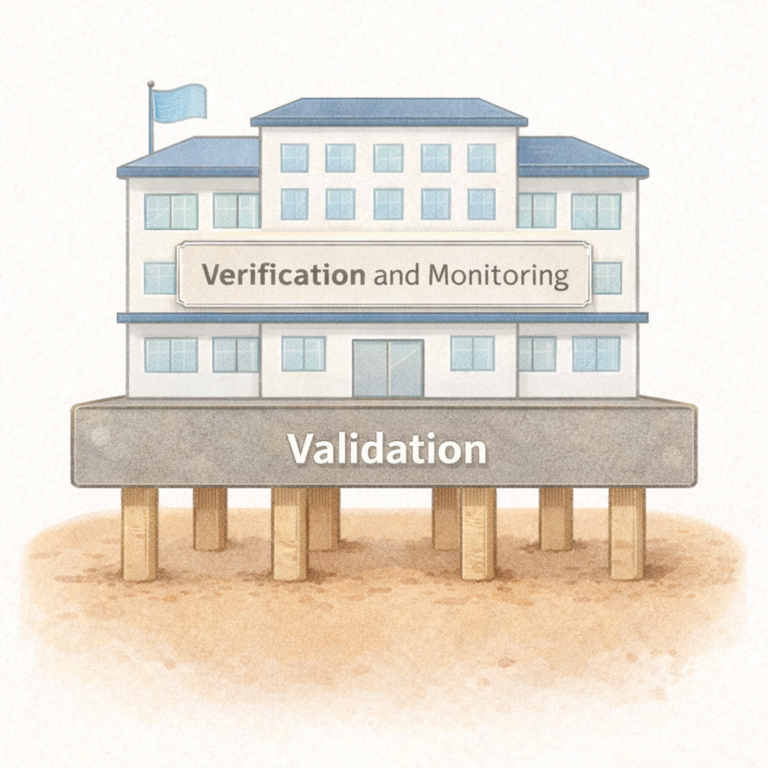
Many food businesses in Singapore use the words validation and verification as if they mean the same thing. However, they do not. This confusion creates real operational risk.
Employees fill forms. Managers sign forms. Audits pass. Yet the system may not truly control hazards. When this happens, the food safety management system (FSMS) becomes paperwork instead of protection.
If you operate a central kitchen, food production facility, or an F&B chain, you must understand the difference between process validation and verification. More importantly, you must know when to apply each one.
As ISO 22000 consultant in Singapore, we often see this gap during internal audits and system reviews. Let’s clarify it properly.
What is process validation?
Validation answers one simple question: Will this control measure work before we rely on it?
- Does this cooking step really destroy the target pathogen?
- Does this chilling time actually reduce bacterial growth?
- Will this metal detector detect the smallest metal fragment of concern?
- Does this cleaning procedure remove allergens effectively?
Validation is science-based. It relies on:
- Scientific literature
- Regulatory guidance
- Microbiological data
- Supplier technical data
- In-house challenge tests
What is verification?
Verification answers a different question: Is the system working as planned?
Verification happens after implementation. It checks whether your validated control measures operate consistently. Examples of verification activities include:
- Internal audit ISO 22000 programmes
- Review of CCP monitoring records
- Calibration checks
- Environmental swab testing
- Management review meetings
- Trend analysis of non-conformities
Verification does not prove the science behind the control measure. Instead, it confirms that:
- Staff follow procedures
- Records are accurate
- Equipment performs correctly
- Monitoring remains effective
Why food businesses confuse them
There are three common reasons for confusion.
1. Over-reliance on monitoring records
Many SMEs believe that reviewing monitoring logs equals validation. However, log review is verification. Monitoring only shows what happened. Validation confirms that it is scientifically sound even before it happens.
2. Audit-driven mindset
Some businesses focus on passing SFA/HACCP compliance inspections. Therefore, they prepare files for audit but do not revisit scientific assumptions behind controls. Passing inspection does not mean the control measure was validated properly.
3. Weak HACCP foundation
If the hazard analysis is shallow, validation becomes superficial. For example: If you identify “bacteria” as a general hazard but do not specify Salmonella or Listeria, your validation cannot be precise. Strong HACCP implementation projects in Singapore always begin with detailed hazard identification.
Where ISO 22000 draws the line
ISO 22000 clearly separates:
- Validation of control measure combinations
- Verification of the food safety management system
Clause requirements demand that organisations:
- Validate control measures before implementation
- Plan verification activities
- Define frequency and responsibility
- Review results systematically
Therefore, validation is not optional. It is a structural requirement of a food safety management system Singapore businesses must comply with.
Real-world example from a central kitchen
Consider a central kitchen Singapore operator producing ready-to-eat meals.
Situation
They cook curry chicken in large kettles. Their HACCP plan states:
- Cook to 80°C core temperature
- Cool to below 5°C within 4 hours
However:
- No scientific reference supports the cooling time
- No load validation was done
Practical differences at operational level
To make it clearer, compare them directly.
Validation
- Conducted before implementation
- Science-based
- Hazard-specific
- Often one-time or triggered by change
- Supports HACCP design
Verification
- Conducted after implementation
- System-based
- Checks consistency
- Ongoing and scheduled
- Supports system performance
When re-validation is required
Validation is not permanent. You must re-validate when:
- You change raw material suppliers
- You increase batch size
- You modify equipment
- You alter cooking or cooling times
- You introduce new packaging
- You receive repeated microbiological failures
How this links to internal audits
Many businesses treat internal audit ISO 22000 activities as a compliance exercise.
However, internal audit should ask:
- Where is the validation evidence?
- Is the hazard analysis still current?
- Have we documented scientific justification?
- Have recent changes triggered re-validation?
This connects directly to previous topics such as:
- ISO 22000 audit preparation
- Supplier approval ISO 22000 systems
How to structure validation properly
If you want to strengthen your food production systems, follow this framework:
Step 1: Define the hazard clearly
Do not write “microbial hazard.” Specify:
- Salmonella
- Listeria monocytogenes
- Clostridium perfringens
Clarity determines validation strength.
Step 2: Identify measurable control parameters
For example:
- Temperature
- Time
- pH
- Water activity
Step 3: Gather scientific justification
Use:
- Published research
- Regulatory guidelines
- Expert consultation
- Challenge testing
Step 4: Document validation rationale
Explain:
- Why the parameter works
- What hazard it controls
- What assumptions apply
Step 5: Integrate into monitoring and verification plan
Validation informs CCP limits. Verification checks compliance. This is how HACCP implementation projects in Singapore should be structured.
The business impact of getting this wrong
When validation is weak:
- Shelf life becomes guesswork
- Micro failures appear unexpectedly
- Recalls become more likely
- Brand trust declines
- Scaling becomes risky
On the other hand, when validation is strong:
- Production becomes predictable
- Audit discussions become confident
- Expansion becomes controlled
- Management decisions rely on data
Final advisory: move beyond paperwork
Many food businesses maintain thick files. However, thick files do not guarantee safe food. Ask yourself:
- Have we validated our critical control measures scientifically?
- Or are we only verifying paperwork?
We help food businesses to recenter themselves and move forward with confidence. That begins with systems that work in reality, not only on paper.
Food Forward is here to help you.
Get in touch with us today!