
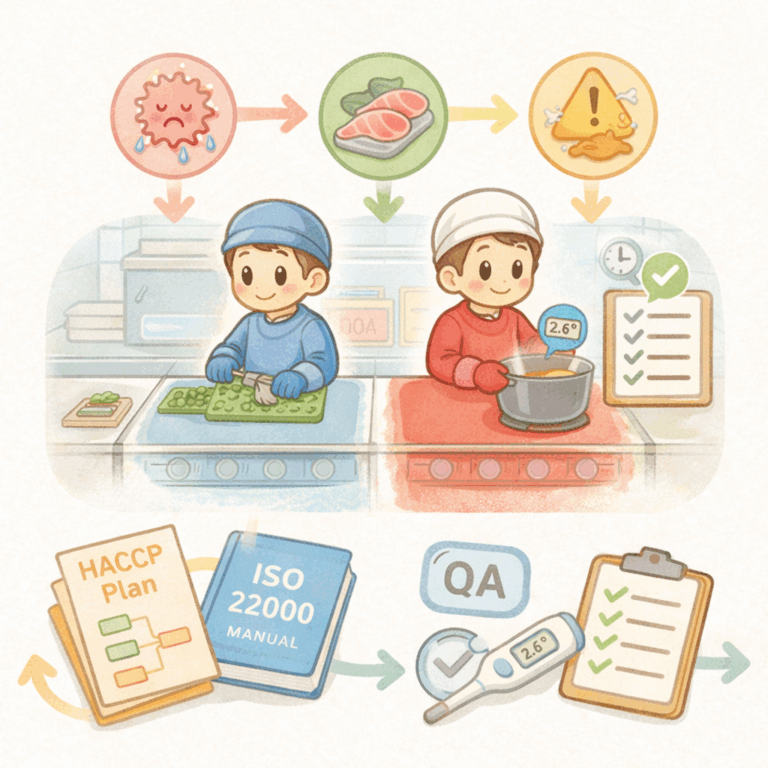
How HACCP and ISO 22000 are related to Quality Assurance in food production
Many food businesses in Singapore try to improve food safety by focusing only on results. They check the final product, review lab reports, and wait for issues to appear. However, quality assurance works very differently. Strong QA begins much earlier and depends on the daily systems that guide how food is produced.
This is where HACCP and ISO 22000 become essential tools. Together, they shape how a food business controls hazards, manages risks, and builds safe and consistent food production processes. When both systems feed into a structured QA process, they help teams prevent problems instead of reacting to them.
In this article, we explore how HACCP and ISO 22000 support QA work and why it matters for every kitchen, central kitchen, and food production facility in Singapore.
What quality assurance really means in food production
Quality assurance is often confused with quality control. The two are related, but they are not the same.
Quality control checks products after they are made. It is a reactive process. It tells you if something has gone wrong, but only at the end.
Quality assurance works earlier. QA looks at the steps that create quality. It uses systems, training, documentation, and monitoring to make sure food stays safe and consistent before it reaches the customer. Because of this, QA fits naturally with food production, where every small step affects the final product.
A strong QA system also gives clear guidelines to the team. It sets expectations and helps everyone understand how their work links to food safety. When QA is strong, the entire production flow is more structured, and the risks are easier to control.
How HACCP forms the foundation of quality assurance in food production
HACCP is the base of every modern food safety system. It works well because it focuses on the real risks that affect food production. When done properly, HACCP gives a clear picture of what may go wrong and how to prevent it.
HACCP supports QA by helping to:
- Identify hazards in ingredients, processes, equipment, and staff behaviour
- Understand which steps are most risky
- Set up control measures for each risk
- Monitor key steps to make sure they stay safe
Because QA is about prevention, HACCP becomes a practical tool. It helps teams know what to watch, what to record, and how to react when something changes.
How HACCP supports daily QA in food production:
- Incoming goods checks rely on the hazard analysis
- Staff follow clear processes for handling raw and cooked food
- Teams monitor temperature and time to control hazards
- Allergen risks stay visible and controlled
- Cleaning reduces cross-contamination and builds consistency
As a result, HACCP becomes the foundation that guides safe behaviour in the kitchen or food factory.
How ISO 22000 strengthens quality assurance systems in food production
HACCP is strong, but it focuses mainly on hazards. ISO 22000 builds an entire management system around HACCP. It connects leadership, documentation, verification, and continual improvement into one organised framework. This makes QA stronger and easier to maintain.
Management commitment
Leaders must support the system. When management is involved, QA becomes part of everyday work rather than a one-time effort.
Documentation discipline
ISO 22000 requires clear procedures, work instructions, and records. This structure helps teams stay consistent and makes operations and audits much easier.
Supplier control
Food production depends on safe ingredients. ISO 22000 requires businesses to verify suppliers, maintain records of their licences, and review their performance.
Verification and improvement
Internal audits, mock recalls, and corrective actions keep the system active. These tools make QA more reliable and more transparent.
Staff training
Training is a major part of ISO 22000. Teams need to understand hazards, procedures, hygiene rules, and how to respond during emergencies.
Because of this, ISO 22000 transforms HACCP from a plan into a complete QA system that supports food production from end to end.
Related reading:
How to build a supplier approval system under ISO 22000.
Strong supplier control supports both food safety and quality assurance in food production.
How HACCP and ISO 22000 support daily quality assurance in food production
HACCP and ISO 22000 work together to support everyday QA activities. When both systems are linked well, the entire food production process feels clearer and easier to control.
Daily QA tasks supported by HACCP and ISO 22000 include:
Incoming goods inspection
Teams check product condition, temperature, COAs, and supplier details.
Process monitoring
Staff record temperature, time, and other key values during each process step.
Environmental hygiene
Zoning, cleaning schedules, and swab results help control cross-contamination.
Allergen management
Clear labels, colour-coded tools, and separation practices protect customers.
Traceability
Batch coding links raw materials to finished products and supports recalls.
Finished product checks
Teams verify appearance, taste, weight, and packaging standards.
Supplier verification
Operators check licences, certificates, and documents regularly.
Handling non-conformities
HACCP and ISO 22000 guide how issues are recorded, corrected, and prevented.
Each task builds on the next. Together, they form a single QA system that is strong, practical, and easy to maintain.
Related reading:
How food traceability supports ISO 22000 compliance
and why it matters for both quality assurance and audit readiness.
Common mistakes food businesses make
Many food businesses try to improve quality, but they struggle because of simple mistakes. These issues often appear during audits or internal reviews.
- Treating QA and food safety as separate departments
- Relying on final product testing instead of strong process control
- Keeping poor documentation or incomplete records
- Allowing supplier files to expire
- Inconsistent labelling and batch coding
- Weak training or unclear SOPs
- No internal audits
- Slow traceability during recall tests
- Over-complicated FSMS forms that staff cannot follow
These problems do not appear overnight. They build slowly when daily routines slip or when standards fall and no one reacts.
How HACCP and ISO 22000 combine into a strong QA system for food production
You can build a strong QA system by making sure HACCP and ISO 22000 connect directly to daily tasks. This is easier than it seems. The goal is to keep the system simple, clear, and structured.
Map your processes
Write down each step of your food production process and link it to your HACCP plan.
Build your controls
Set clear rules for temperature, hygiene, allergen control, and cross-contamination.
Use accurate documentation
Keep forms simple. Record only what is important. Make sure the team understands why each form matters.
Train the team
Use short and practical sessions. Explain the purpose behind each step.
Review supplier approval
Check certificates, verify licences, update files, and schedule re-evaluations.
Run internal audits
A good internal audit finds small issues before they become serious problems.
Test recall and traceability
Choose one product and test how fast you can trace ingredients and batches.
Improve regularly
Small and steady improvements make the system stronger over time.
When these steps are consistent, QA becomes a natural part of food production work.
Related reading:
How internal audits strengthen ISO 22000 food safety systems,
especially for central kitchens and food production facilities.
Why HACCP, ISO 22000, and quality assurance matter for food production in Singapore
Singapore has strict and well-developed food regulations. Because of this, a strong QA system gives operators several advantages.
- Smoother SFA inspections
- Fewer customer complaints
- Stronger confidence from clients and partners
- Better control during audits
- Lower risk of recalls
- Clearer structure when scaling a central kitchen or food factory
- Better consistency across multiple outlets
For businesses that want to grow, a well-built QA system supports new product lines, contract manufacturing, and export opportunities.
Final thoughts
HACCP and ISO 22000 form the backbone of any strong food safety system. However, when you use them together inside a structured QA process, they do much more. They bring clarity, consistency, and control to your food production operations.
A well-built QA system protects your customers, your brand, and your team. It also supports better decisions and makes food safety more natural and less stressful.
If you want to strengthen your QA process or align your system with HACCP and ISO 22000, Food Forward can help you design a practical, effective, and audit-ready approach.
Food Forward is here to help you.
Get in touch with us today!